A Very Rare Gilt Copper Pricket Candlestick 13th Century Limoges & Later from renowned Collection of Nicolas Landau
An incredibly rare, precious and striking piece of Objet d’art from the collection of renowned Parisian antiques dealer Nicolas Landau’s (1887-1979) “the Prince of antique dealers” ‘Rue du Cirque’ collection.
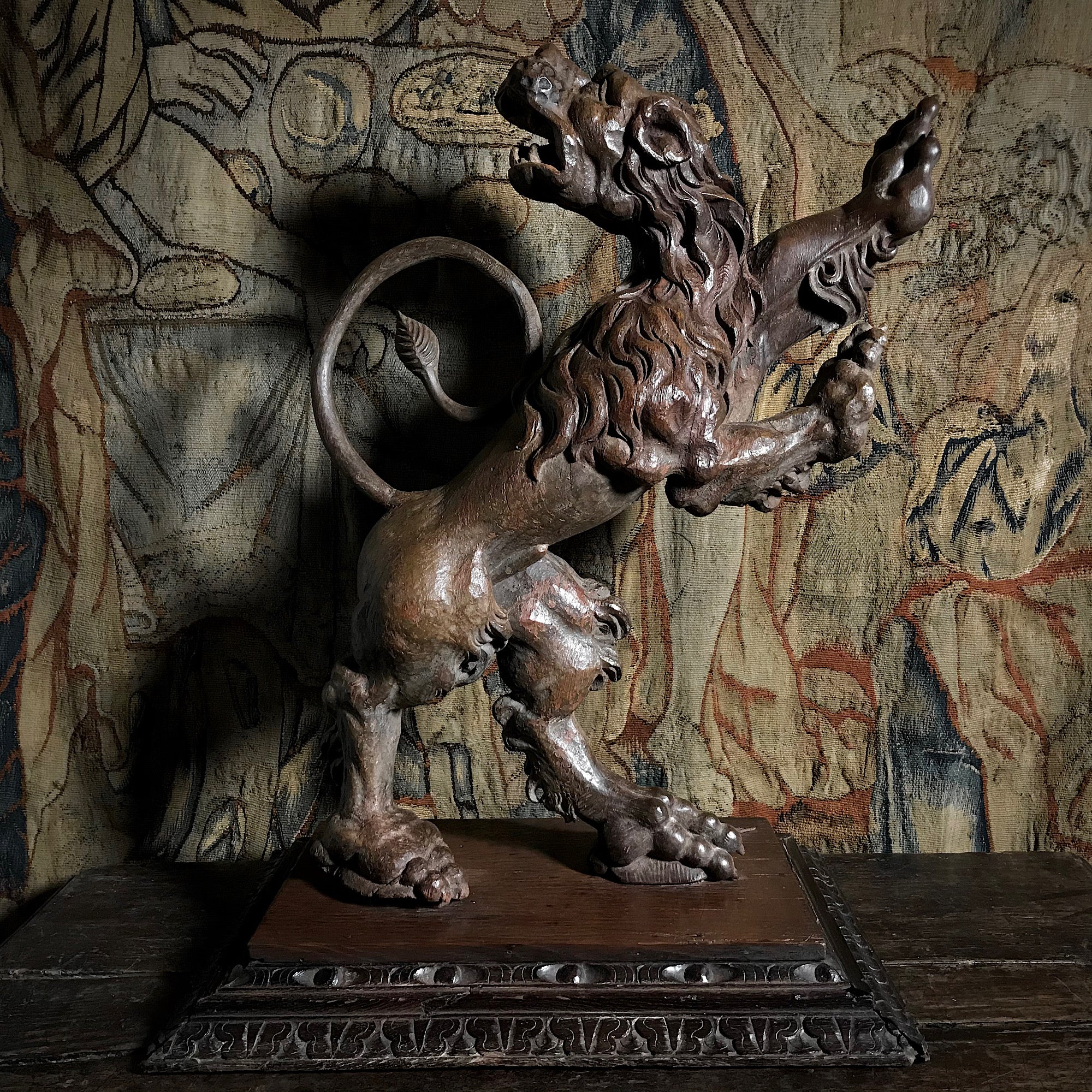
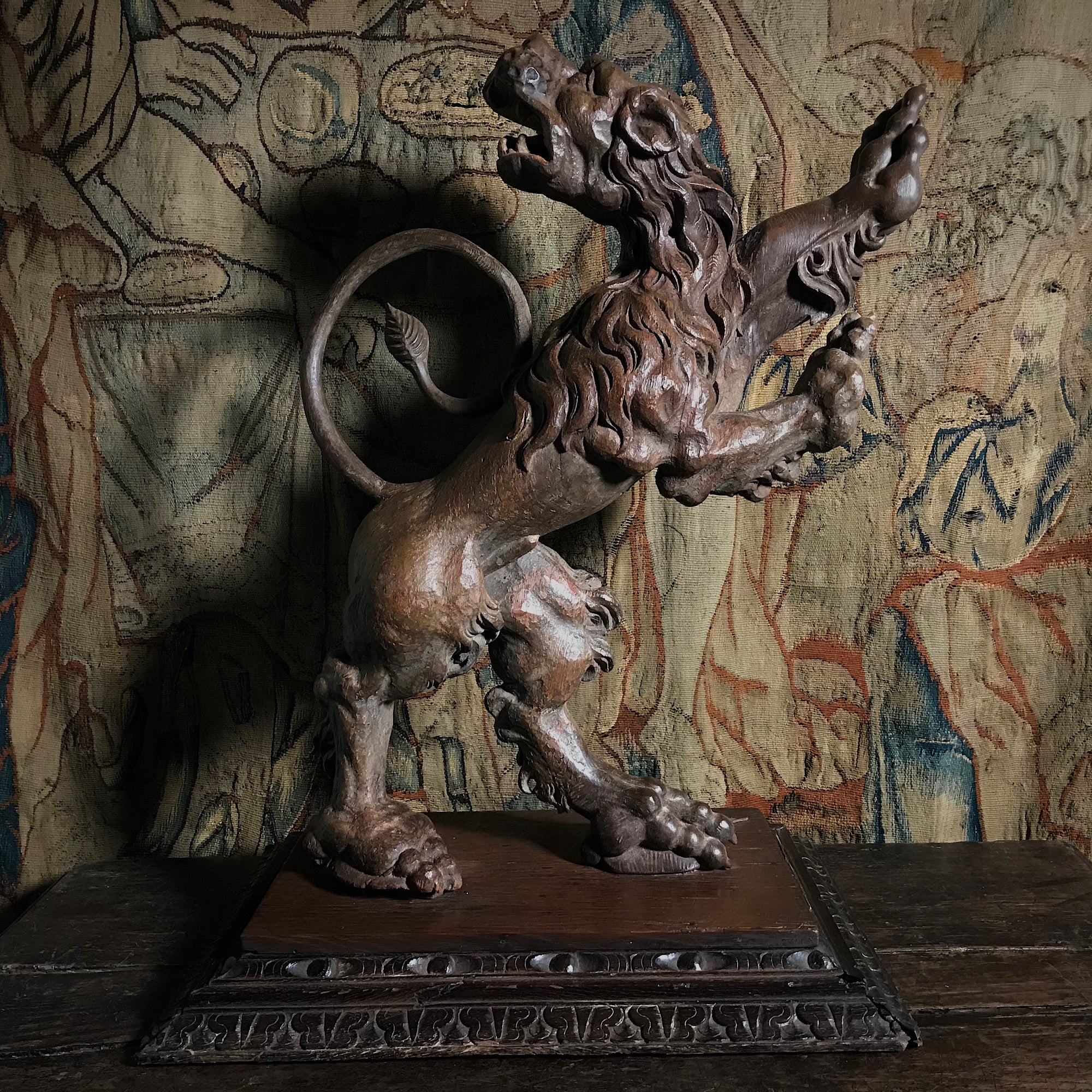
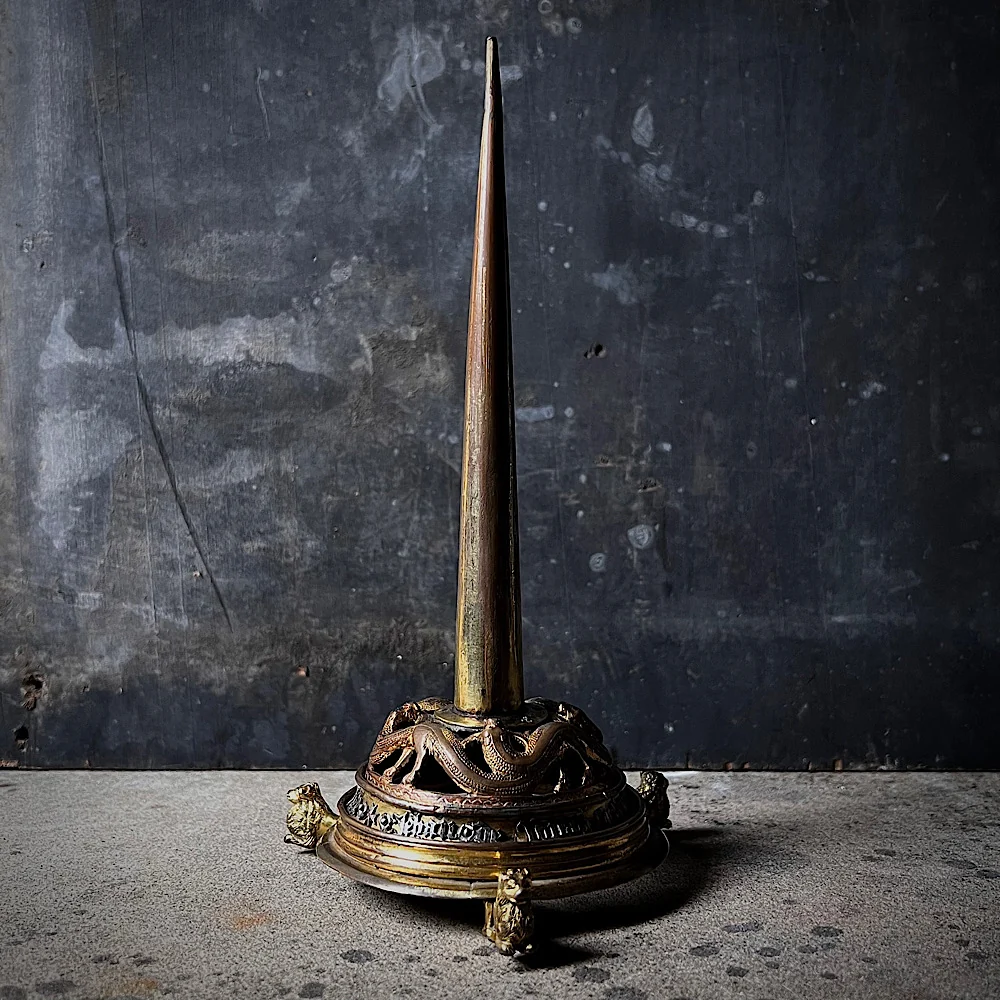
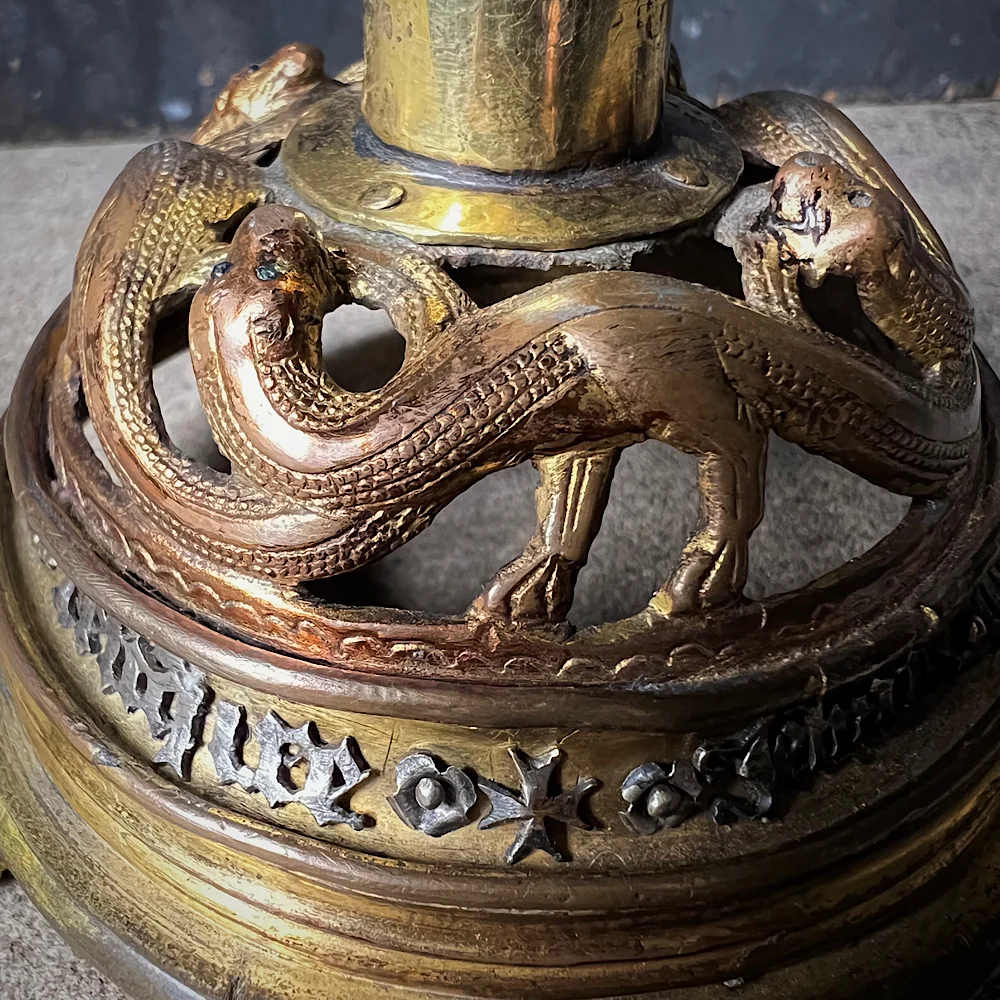
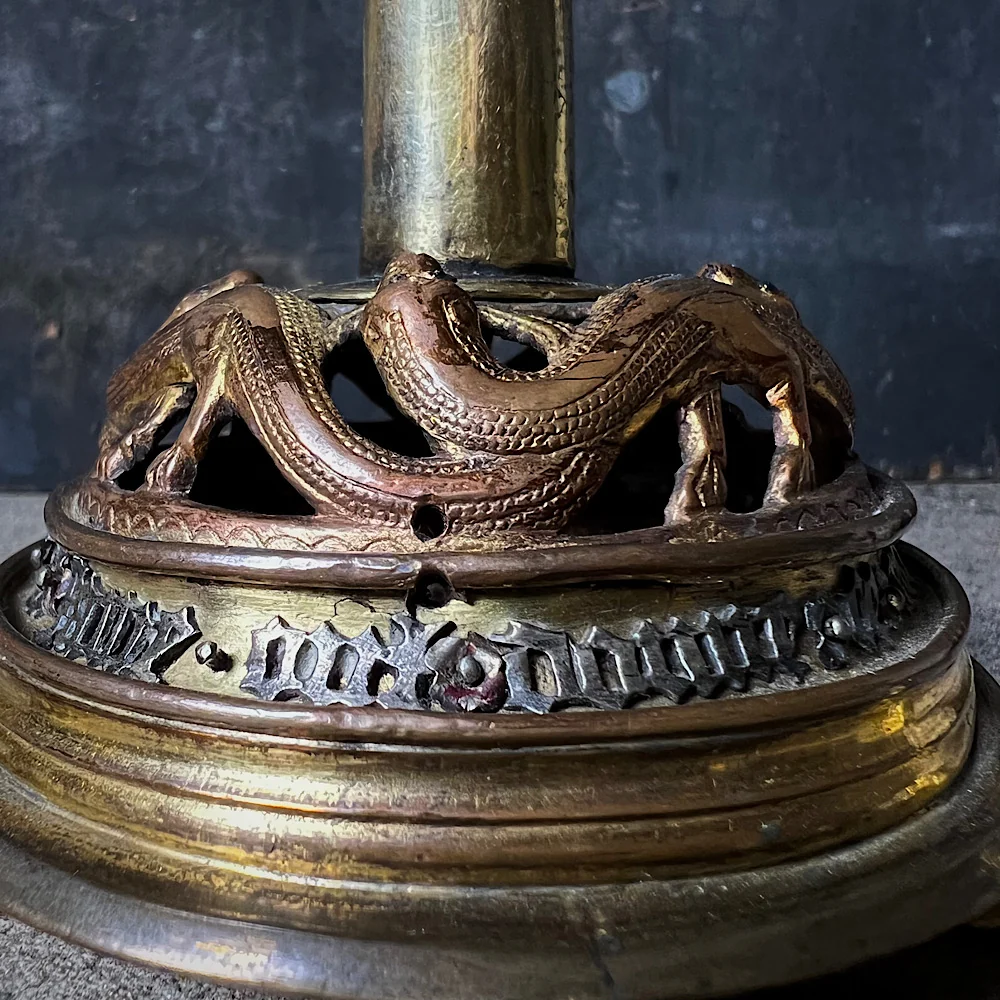
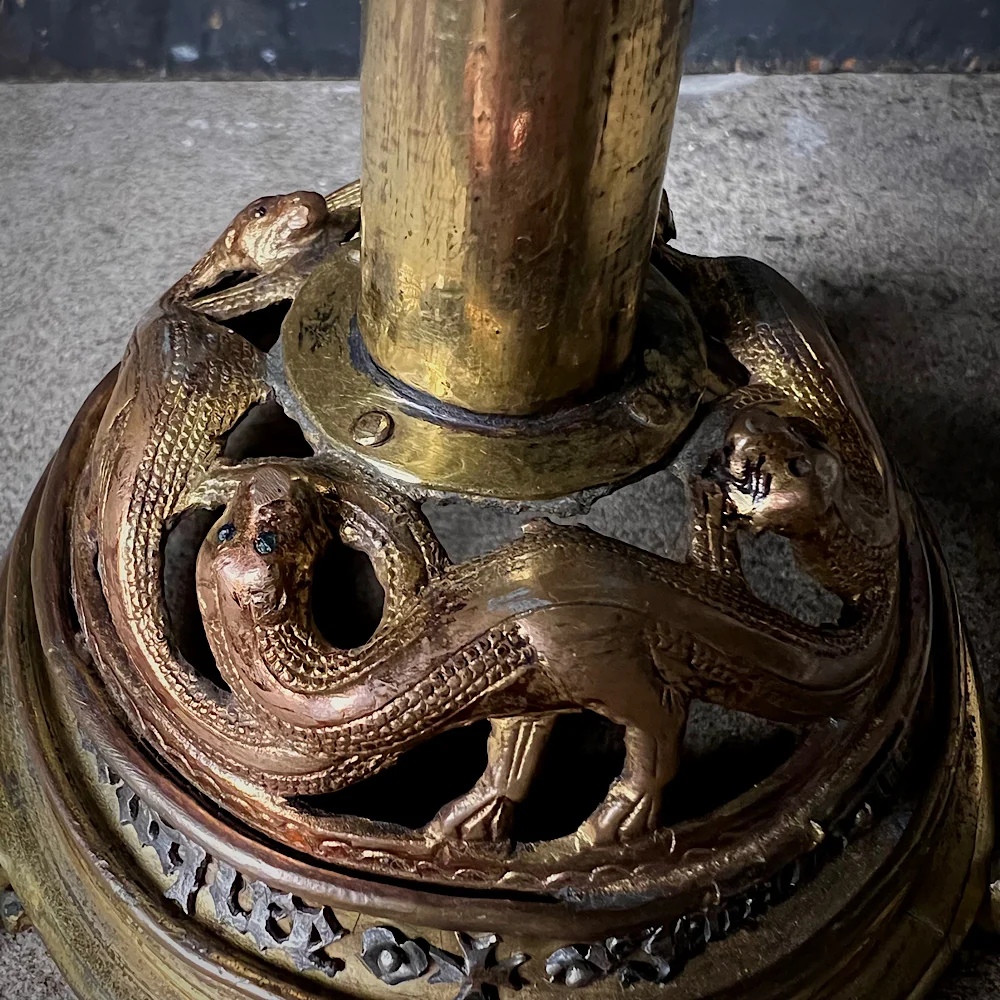
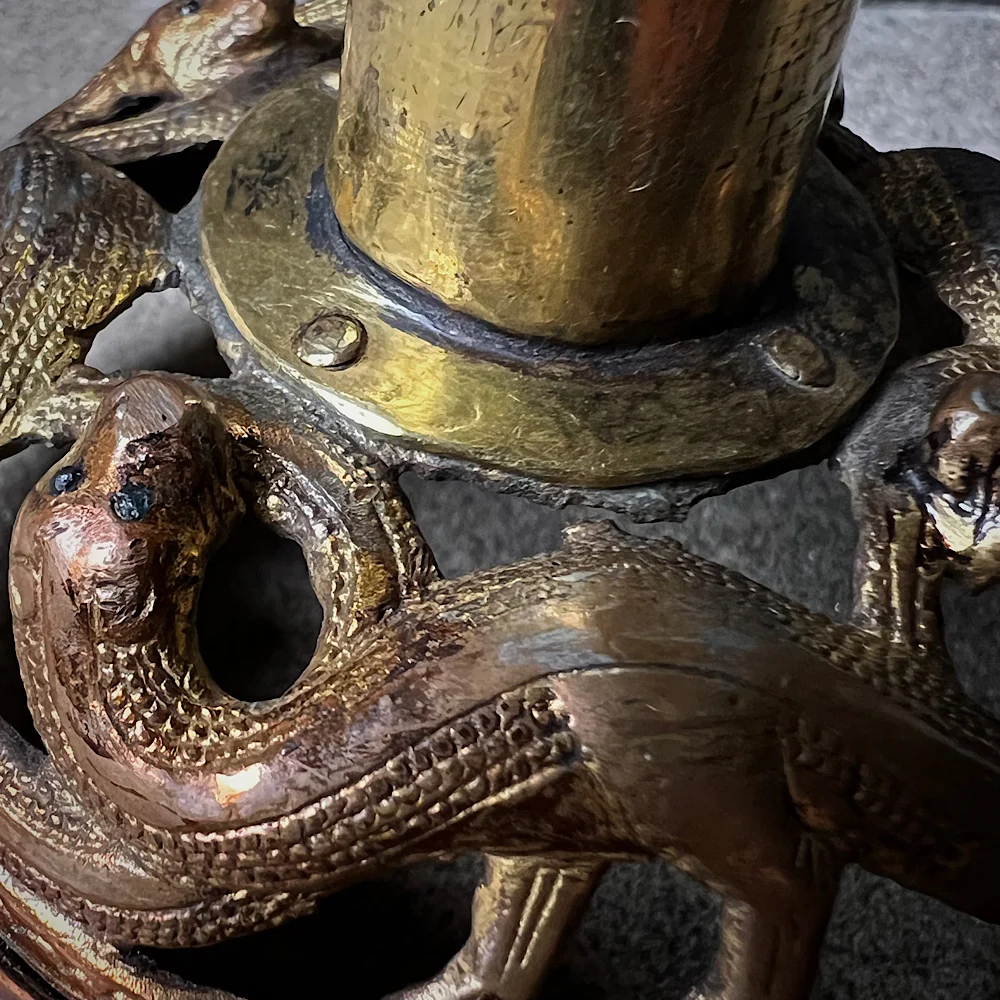
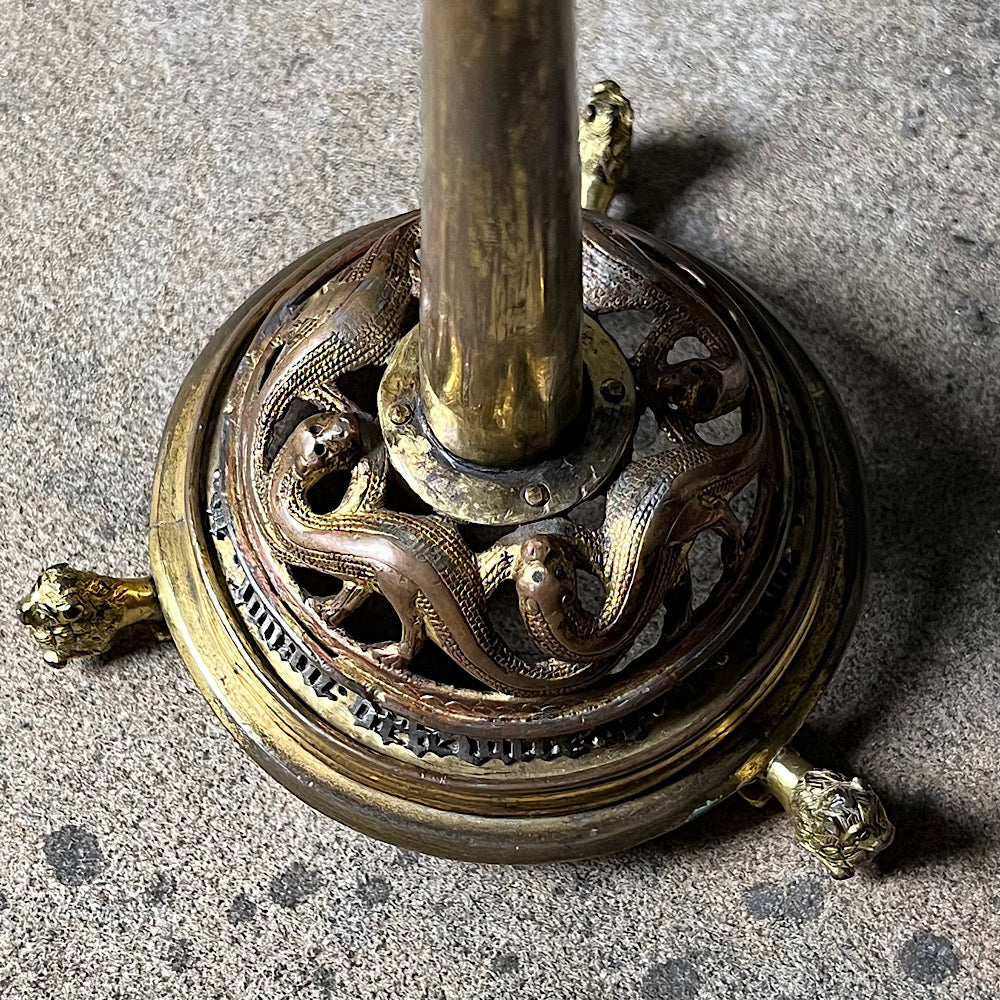
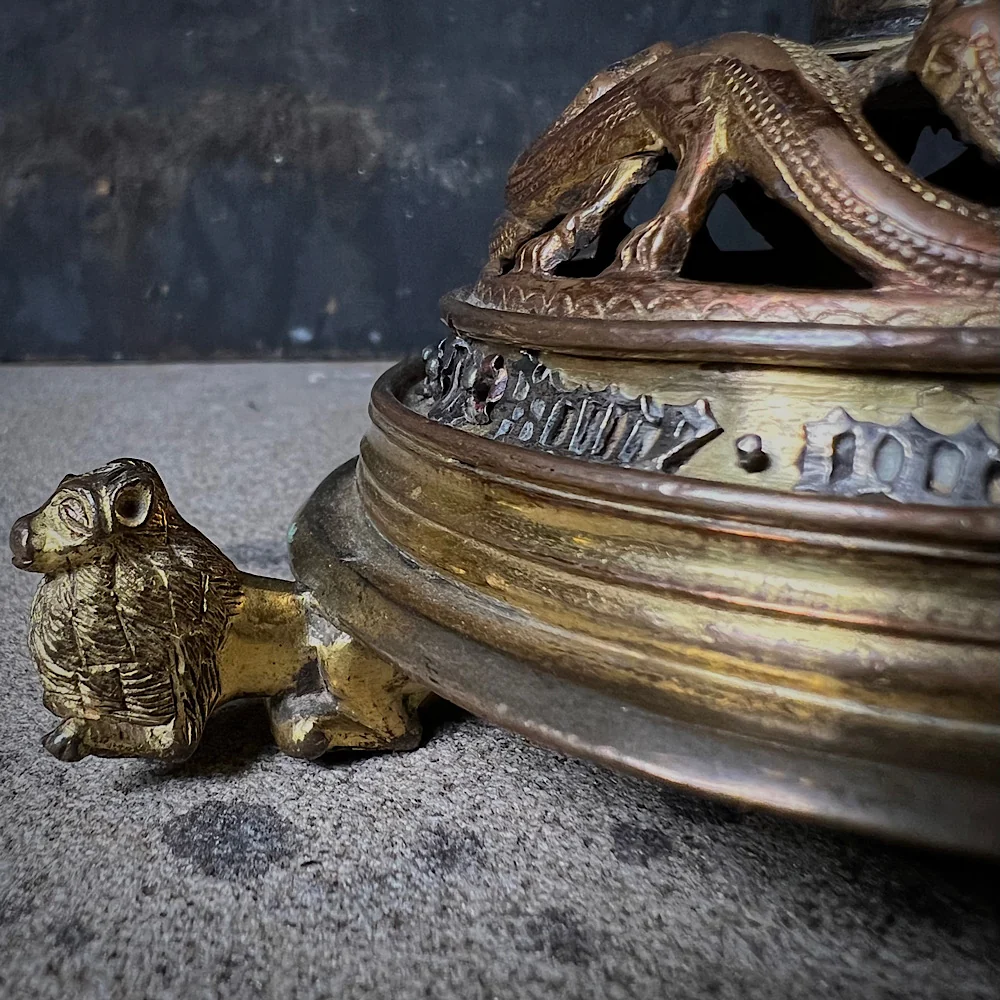
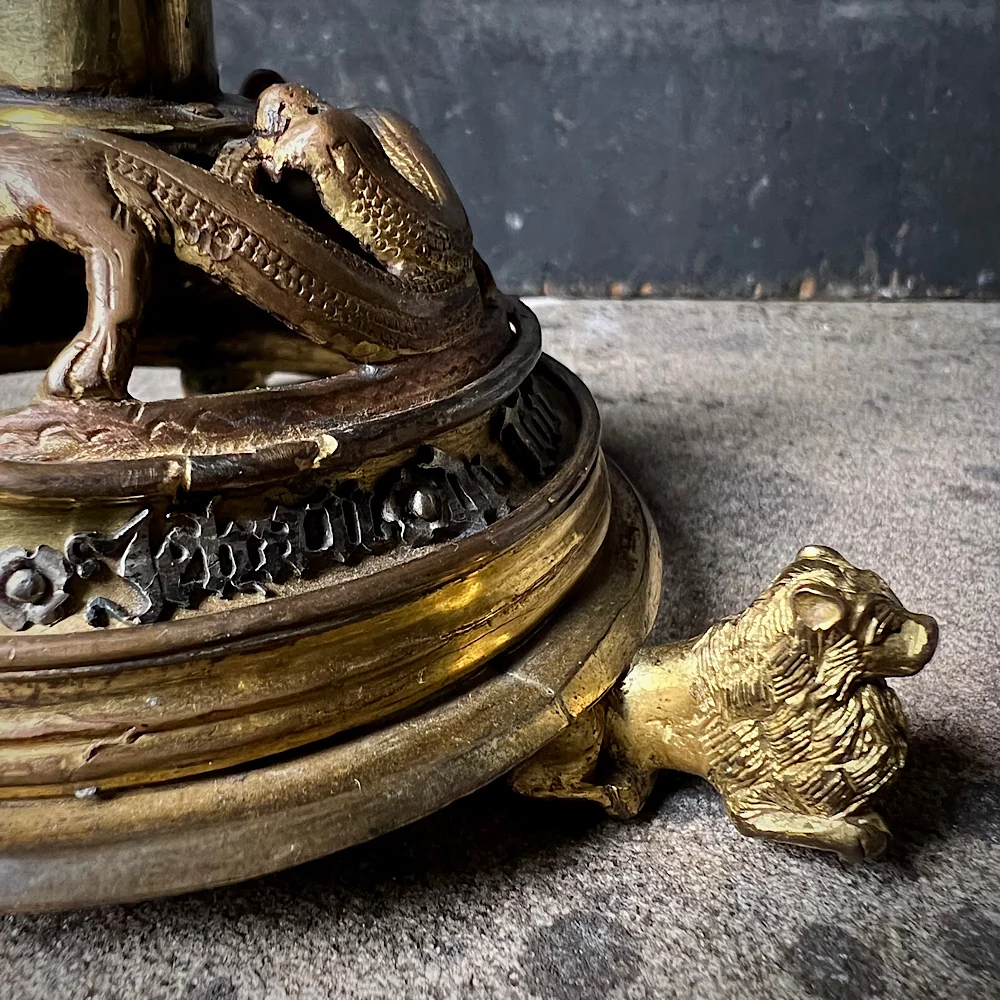
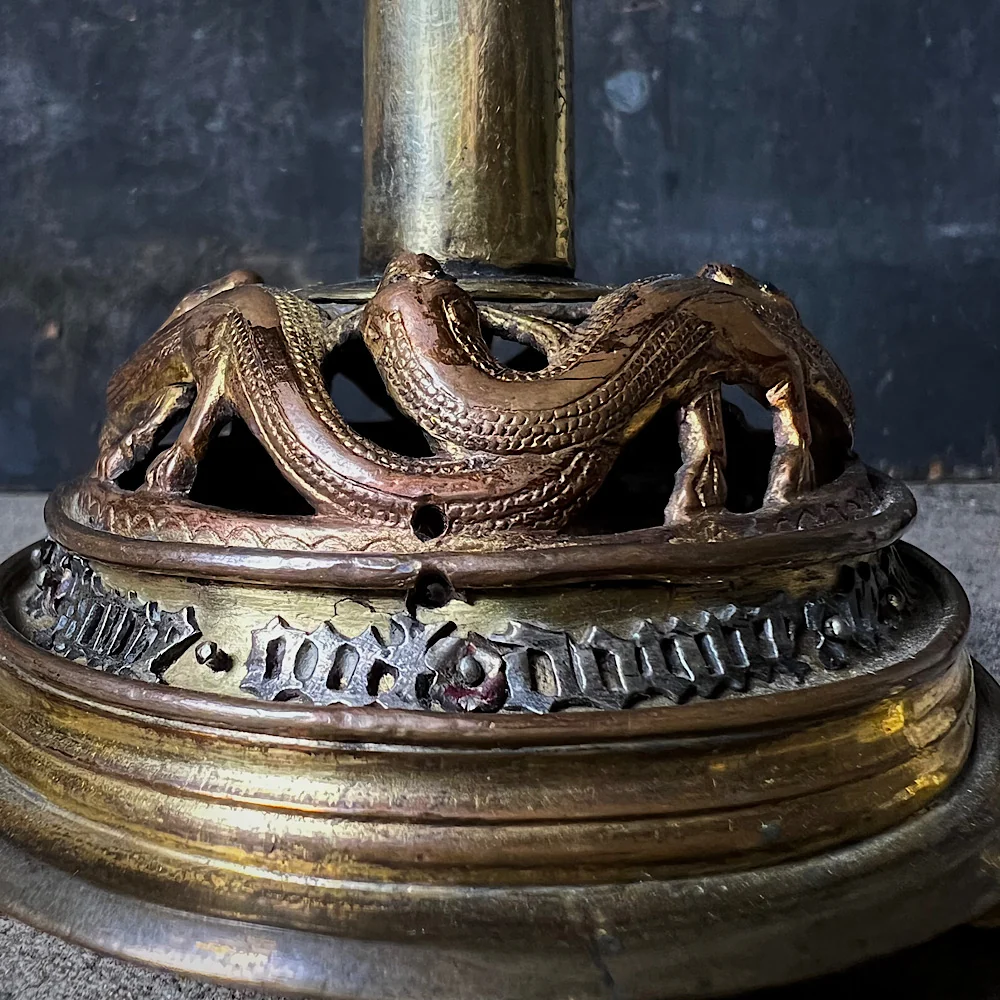
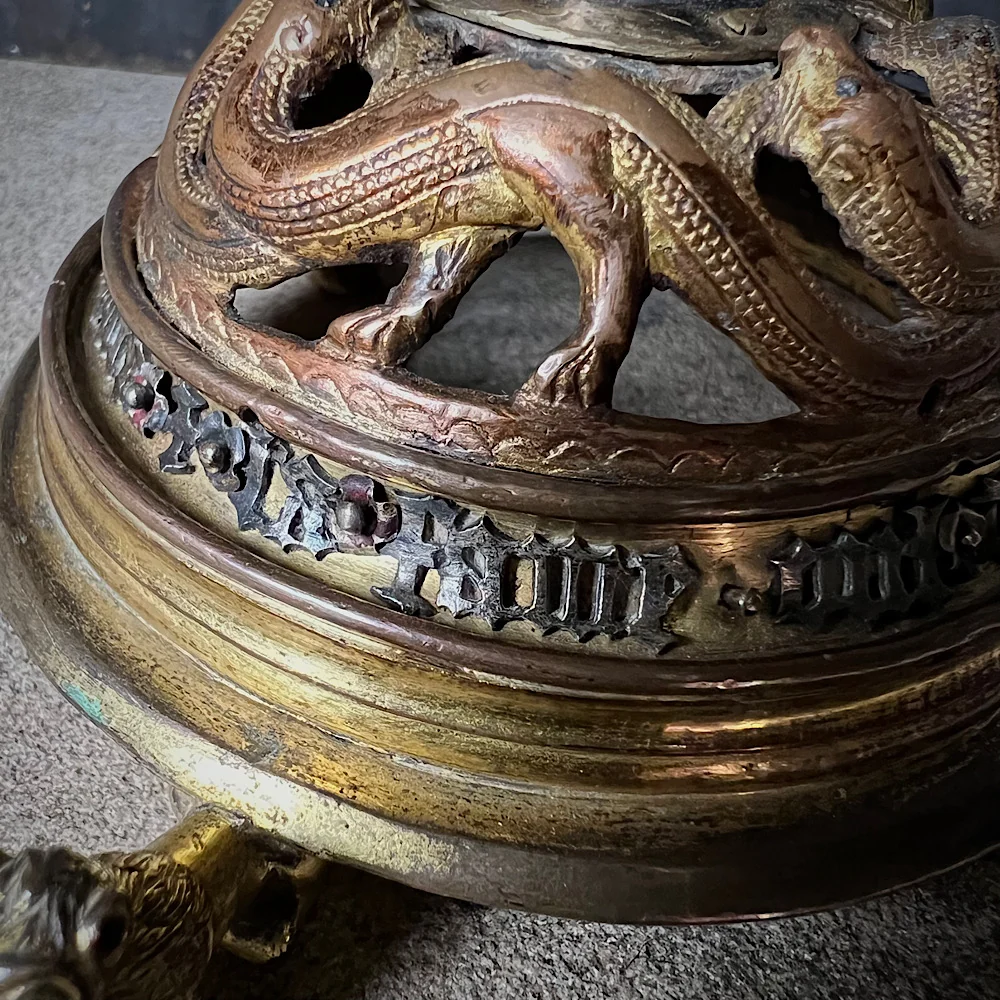
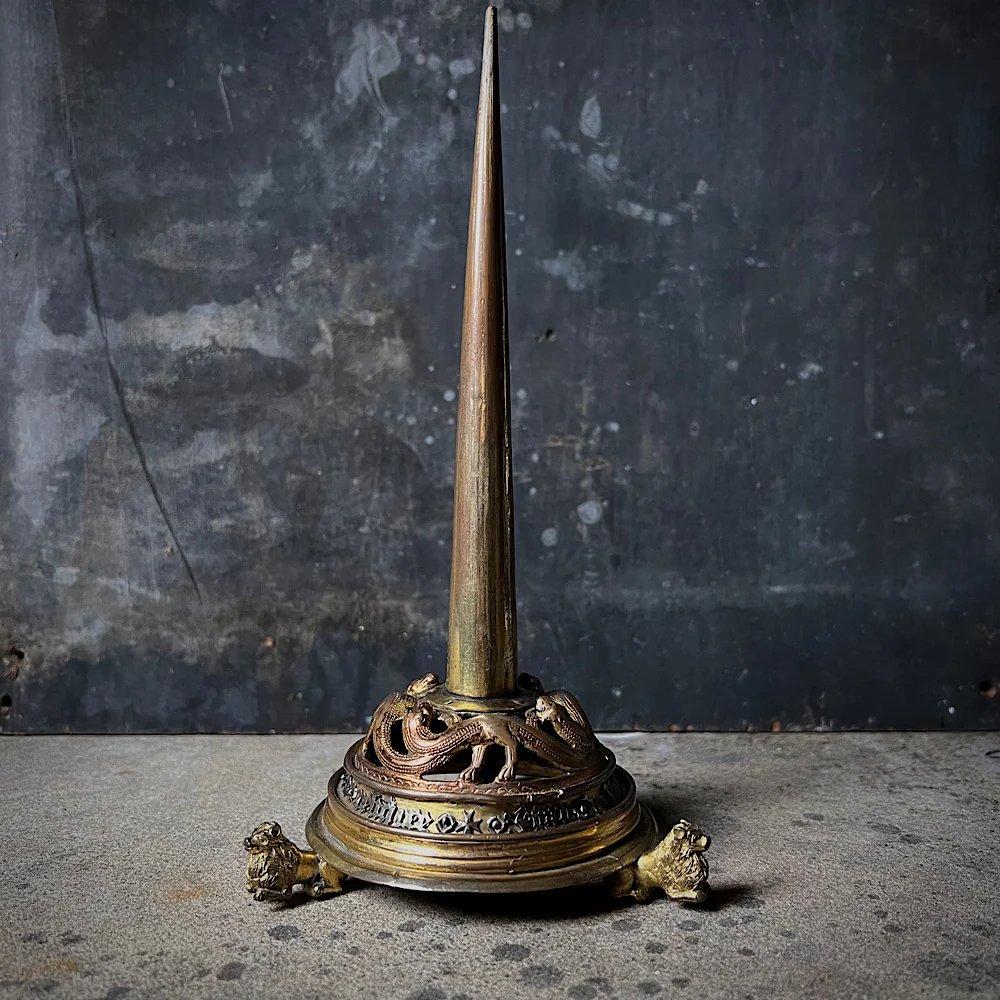
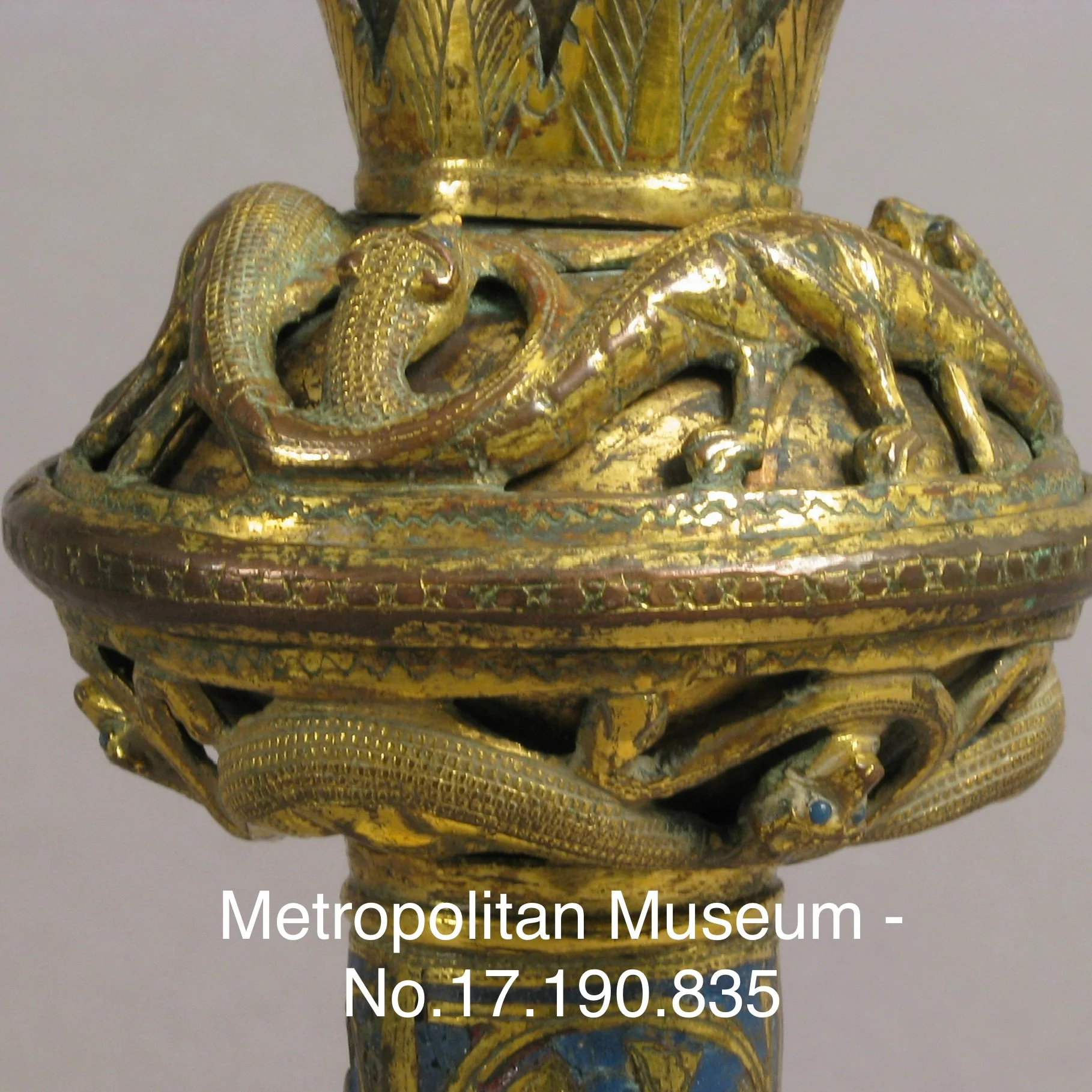
This mesmerising Gothic work of art is created from a 13th Century (1225-50) Limoges openwork knop as the base. Copper formed and gilded, engraved, chased, scraped, stippled gilt pierced and chiselled. Around the knop is a tumble of writhing Salamanders hypnotically whirling in synchronisation, biting at each other’s tails - perhaps conjuring fire - around the base of a later conical pricket candlestick. Below the knop base is a moulded ledge with text in applied silver gothic font, punctuated by tiny enamelled flowers. The stand is supported by three glorious intricately detailed 15th century recumbent Lions. The knop ‘base’ element is originally part of the head of a Crosier staff, later recomposed into the pricket candlestick, probably still for ecclesiastical use within the Church.
The symbolism of the Salamander and their mythical connotations makes this piece even more alluring. As far back as the Ancient Greeks, by 4th Century BCE Aristotle and Theophrastus referred to its emergence as a sign of rain. Pliny wrote of several traits including the reptiles ability to extinguish fire with the frigidity of their bodies. At the end of the Classical era, descriptions of the Salamander became even more fantastical, in Medieval European bestiaries they include:”a worm penetrating flames”(12th Century); “a small bird in flames” (13th Century). Salamanders are often symbolic of their affinity with fire, specifically elemental fire. They are able to tolerate flames through the defence of their naturally moist skin. Their myths grew from witnesses trying to explain how they survived emerging from fire. In the 16th Century Paracelsus in his work “A Book on Nymphs, Sylphs, Pygmies, and Salamanders, and on the Other Spirits”, the author divided the four elements into archetypes, the Salamander (or Vulcanus) being of fire.
Nicolas Landau was one of the greatest antique dealers of the 20th Century. He was a true collector and director of ancient objects.
The Kugel brothers and Axel Vervoordt collaborated and acquired the majority of his private collection from Rue Du Cirque, Paris, curating a renowned exhibition in celebration of the collection “Hommage à Nicolas Landau - Prince des antiquaries (1887-1979)” 2006.
Landau has influenced the aesthetic of his contemporaries, through embracing his own unique method of collecting and curating based on unique taste, in-depth knowledge and storytelling talents of a great personality. He defined himself as “specialist of the unsellable”, bringing back a fashion for scientific instruments, vanities, cabinets of curiosity and theatrical rooms filled with trompe l’oeil work. This mysterious object with a wealthy of history, mysticism and symbolism epitomises his aesthetic.
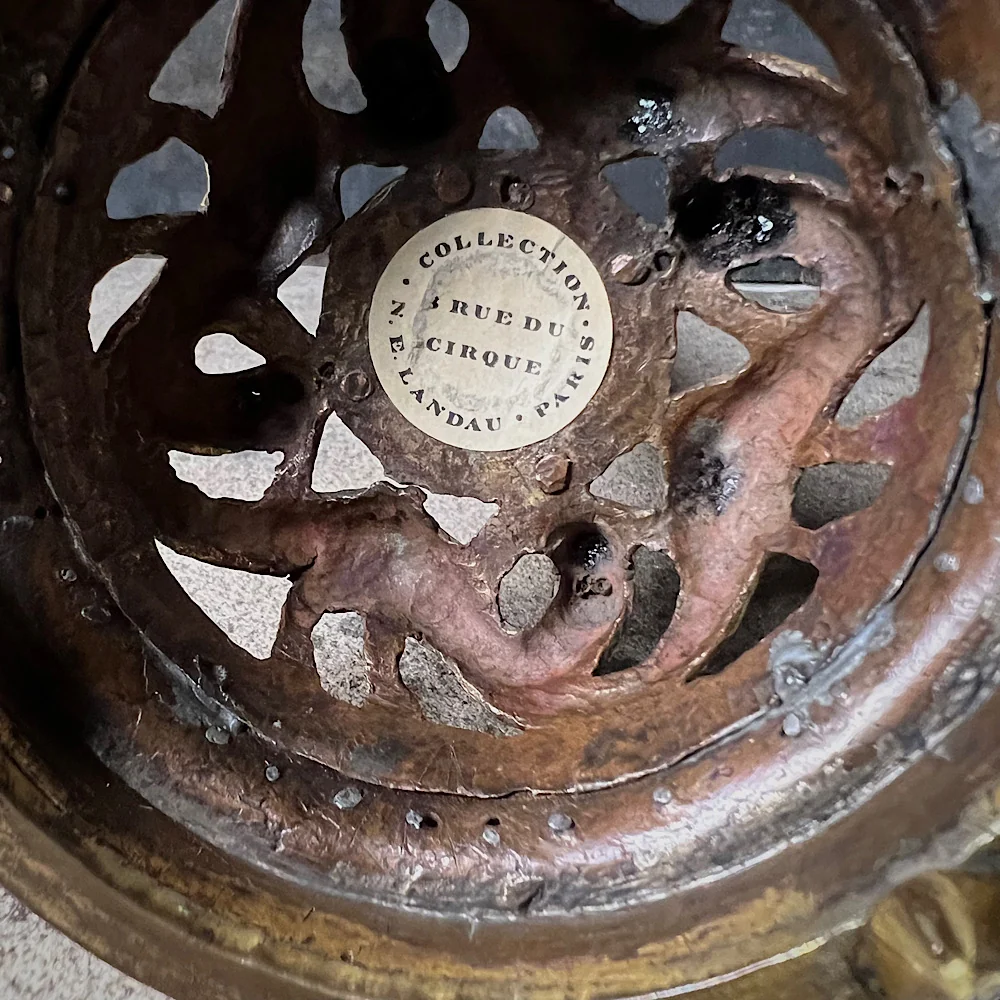
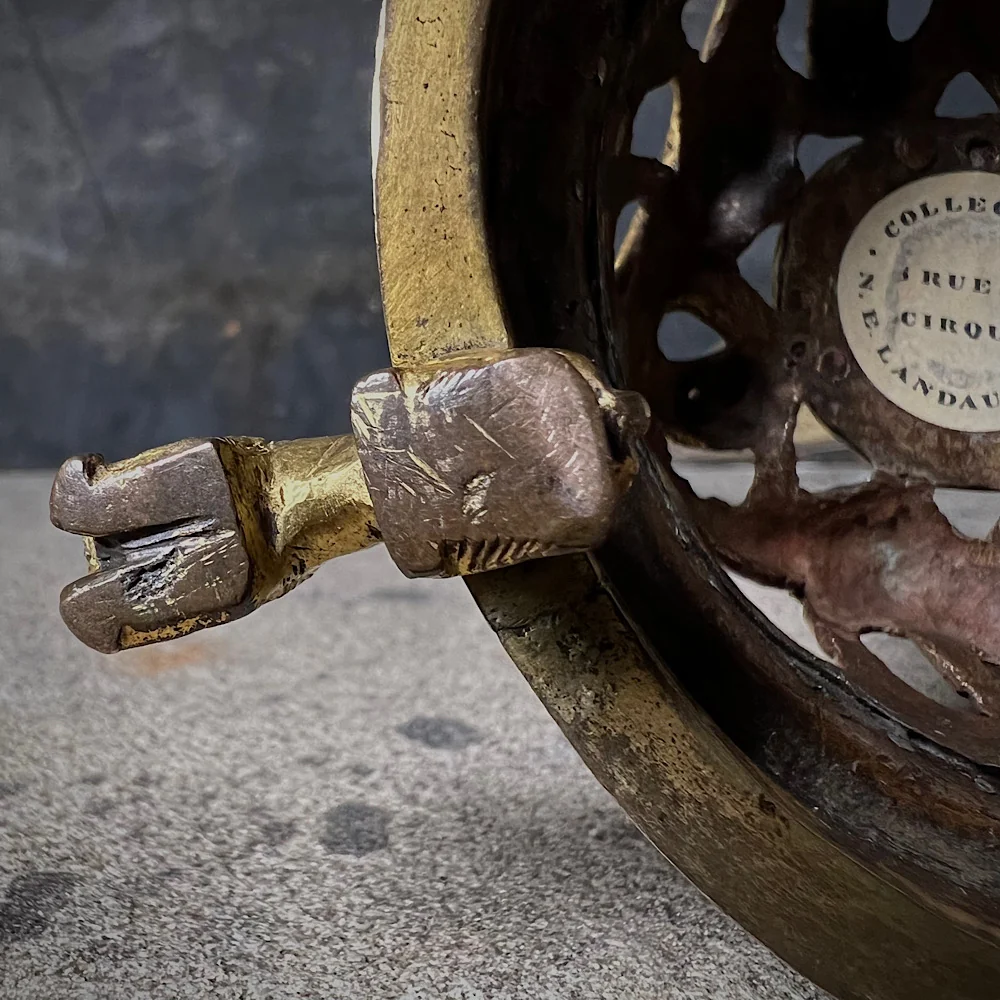
With the original collectors label to the base from collection Rue du Cirque, Paris.
For similar reference see the Metropolitan Museums collection No. 17.190.835 ‘Head of a Crozier with the Annunciation’, and the Crozier from Sotheby’s 5 Dec 2012, Lot 8, French Limoges ca. 1225-50 (salamander knop) see final image.
Product Information
Product Information
Shipping & Returns
Shipping & Returns
A Very Rare Gilt Copper Pricket Candlestick 13th Century Limoges & Later from renowned Collection of Nicolas Landau
A Very Rare Gilt Copper Pricket Candlestick 13th Century Limoges & Later from renowned Collection of Nicolas Landau
An incredibly rare, precious and striking piece of Objet d’art from the collection of renowned Parisian antiques dealer Nicolas Landau’s (1887-1979) “the Prince of antique dealers” ‘Rue du Cirque’ collection.
This mesmerising Gothic work of art is created from a 13th Century (1225-50) Limoges openwork knop as the base. Copper formed and gilded, engraved, chased, scraped, stippled gilt pierced and chiselled. Around the knop is a tumble of writhing Salamanders hypnotically whirling in synchronisation, biting at each other’s tails - perhaps conjuring fire - around the base of a later conical pricket candlestick. Below the knop base is a moulded ledge with text in applied silver gothic font, punctuated by tiny enamelled flowers. The stand is supported by three glorious intricately detailed 15th century recumbent Lions. The knop ‘base’ element is originally part of the head of a Crosier staff, later recomposed into the pricket candlestick, probably still for ecclesiastical use within the Church.
The symbolism of the Salamander and their mythical connotations makes this piece even more alluring. As far back as the Ancient Greeks, by 4th Century BCE Aristotle and Theophrastus referred to its emergence as a sign of rain. Pliny wrote of several traits including the reptiles ability to extinguish fire with the frigidity of their bodies. At the end of the Classical era, descriptions of the Salamander became even more fantastical, in Medieval European bestiaries they include:”a worm penetrating flames”(12th Century); “a small bird in flames” (13th Century). Salamanders are often symbolic of their affinity with fire, specifically elemental fire. They are able to tolerate flames through the defence of their naturally moist skin. Their myths grew from witnesses trying to explain how they survived emerging from fire. In the 16th Century Paracelsus in his work “A Book on Nymphs, Sylphs, Pygmies, and Salamanders, and on the Other Spirits”, the author divided the four elements into archetypes, the Salamander (or Vulcanus) being of fire.
Nicolas Landau was one of the greatest antique dealers of the 20th Century. He was a true collector and director of ancient objects.
The Kugel brothers and Axel Vervoordt collaborated and acquired the majority of his private collection from Rue Du Cirque, Paris, curating a renowned exhibition in celebration of the collection “Hommage à Nicolas Landau - Prince des antiquaries (1887-1979)” 2006.
Landau has influenced the aesthetic of his contemporaries, through embracing his own unique method of collecting and curating based on unique taste, in-depth knowledge and storytelling talents of a great personality. He defined himself as “specialist of the unsellable”, bringing back a fashion for scientific instruments, vanities, cabinets of curiosity and theatrical rooms filled with trompe l’oeil work. This mysterious object with a wealthy of history, mysticism and symbolism epitomises his aesthetic.
With the original collectors label to the base from collection Rue du Cirque, Paris.
For similar reference see the Metropolitan Museums collection No. 17.190.835 ‘Head of a Crozier with the Annunciation’, and the Crozier from Sotheby’s 5 Dec 2012, Lot 8, French Limoges ca. 1225-50 (salamander knop) see final image.
Product Information
Product Information
Shipping & Returns
Shipping & Returns
Description
An incredibly rare, precious and striking piece of Objet d’art from the collection of renowned Parisian antiques dealer Nicolas Landau’s (1887-1979) “the Prince of antique dealers” ‘Rue du Cirque’ collection.
This mesmerising Gothic work of art is created from a 13th Century (1225-50) Limoges openwork knop as the base. Copper formed and gilded, engraved, chased, scraped, stippled gilt pierced and chiselled. Around the knop is a tumble of writhing Salamanders hypnotically whirling in synchronisation, biting at each other’s tails - perhaps conjuring fire - around the base of a later conical pricket candlestick. Below the knop base is a moulded ledge with text in applied silver gothic font, punctuated by tiny enamelled flowers. The stand is supported by three glorious intricately detailed 15th century recumbent Lions. The knop ‘base’ element is originally part of the head of a Crosier staff, later recomposed into the pricket candlestick, probably still for ecclesiastical use within the Church.
The symbolism of the Salamander and their mythical connotations makes this piece even more alluring. As far back as the Ancient Greeks, by 4th Century BCE Aristotle and Theophrastus referred to its emergence as a sign of rain. Pliny wrote of several traits including the reptiles ability to extinguish fire with the frigidity of their bodies. At the end of the Classical era, descriptions of the Salamander became even more fantastical, in Medieval European bestiaries they include:”a worm penetrating flames”(12th Century); “a small bird in flames” (13th Century). Salamanders are often symbolic of their affinity with fire, specifically elemental fire. They are able to tolerate flames through the defence of their naturally moist skin. Their myths grew from witnesses trying to explain how they survived emerging from fire. In the 16th Century Paracelsus in his work “A Book on Nymphs, Sylphs, Pygmies, and Salamanders, and on the Other Spirits”, the author divided the four elements into archetypes, the Salamander (or Vulcanus) being of fire.
Nicolas Landau was one of the greatest antique dealers of the 20th Century. He was a true collector and director of ancient objects.
The Kugel brothers and Axel Vervoordt collaborated and acquired the majority of his private collection from Rue Du Cirque, Paris, curating a renowned exhibition in celebration of the collection “Hommage à Nicolas Landau - Prince des antiquaries (1887-1979)” 2006.
Landau has influenced the aesthetic of his contemporaries, through embracing his own unique method of collecting and curating based on unique taste, in-depth knowledge and storytelling talents of a great personality. He defined himself as “specialist of the unsellable”, bringing back a fashion for scientific instruments, vanities, cabinets of curiosity and theatrical rooms filled with trompe l’oeil work. This mysterious object with a wealthy of history, mysticism and symbolism epitomises his aesthetic.
With the original collectors label to the base from collection Rue du Cirque, Paris.
For similar reference see the Metropolitan Museums collection No. 17.190.835 ‘Head of a Crozier with the Annunciation’, and the Crozier from Sotheby’s 5 Dec 2012, Lot 8, French Limoges ca. 1225-50 (salamander knop) see final image.